Publications
Corporate Crimes


Corporate Crimes
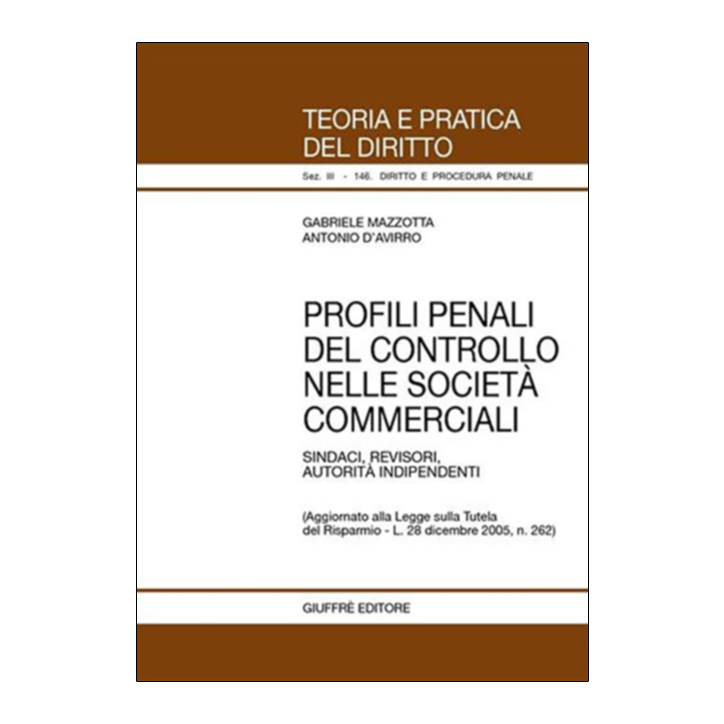
Gabriele Mazzotta, Antonio D’Avirro
Giuffré, 2006.
Recent events that have disrupted the tranquility of millions of savers, damaged by the default of large corporations (Cirio, Parmalat) or by unclear operations of certain banking institutions, make it necessary for legal professionals and practitioners to focus on the regulatory mechanisms that are evidently inadequate in effectively curbing the occurrence of such phenomena. It becomes inevitable to closely observe the institutions that, at least on paper in regulatory provisions, would be functional in preventing misconduct by those who manage commercial companies, so that “attention falls on” the articulation of control instruments. The constitutional foundation of control in and over commercial companies justifies the interest in this topic from criminal law, which has been influenced not only by changes in corporate law, but also by the even more recent partial reform introduced in the T.u.f. with Law No. 62 of April 18, 2005, enacted based on a European directive on market manipulation, whose approval in Italy appeared inevitable following the Cirio and Parmalat scandals, which seem to have awakened the legislator’s interest in the matter of savings protection, as evidenced by Law No. 262 of December 28, 2005. 262. In this field, the interpreter is called upon to verify not only the characteristics of the incriminating norms that see as subjects those who hinder the control function, but also the general criteria for attributing criminal liability to control bodies: in particular to auditors, reviewers, and other independent bodies, such as Consob and the Bank of Italy. An extensive analysis of various corporate crimes in which control bodies may be involved is developed, examining the topic of guarantee positions that these subjects can assume within the corporate system, in light of Art. 40 of the Criminal Code, which introduces the principle of equivalence between the commission of “the event and the violation of” the legal obligation to prevent it. The investigation then addresses the criminal implications of the responsibility of control bodies in relation to crimes such as false accounting, improper corporate bankruptcy, which are closely connected to the functions performed by these subjects, as well as crimes specific to those in charge of control. The topic proves to be particularly current, also because problems related to recent economic scandals are addressed.





 The crimes of
 infidelityin commercial companies