Publications
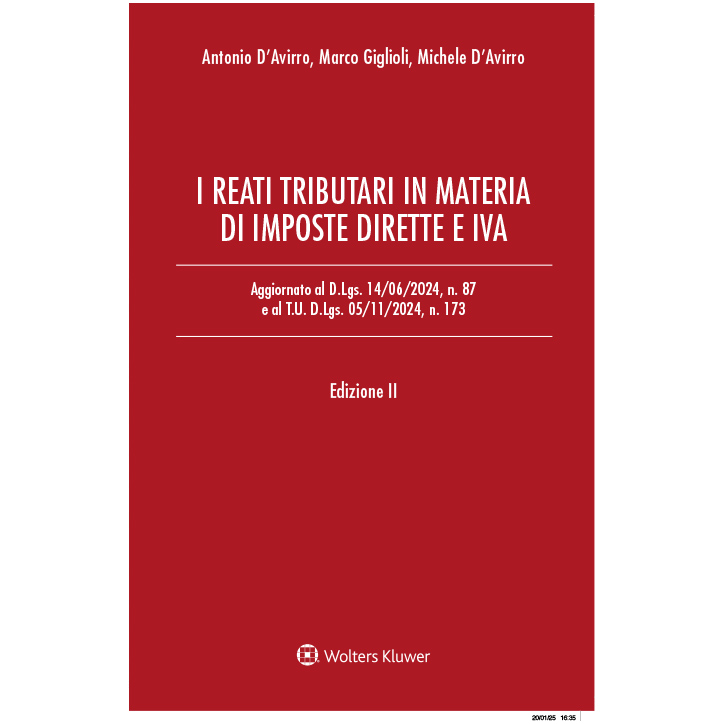
Tax Crimes


Tax Crimes
Antonio D’Avirro, Marco Giglioli, Michele D’Avirro
UPDATED TO LEGISLATIVE DECREE 14/06/2024 No. 87 and to the CONSOLIDATED TEXT LEGISLATIVE DECREE 05/11/2024 No. 173
SECOND EDITION
Wolters Kluwer, 2025
The work systematically addresses all the innovations introduced in the tax criminal system by the recent Legislative Decree 14/06/2024, No. 87, subsequently incorporated into the Consolidated Text of Administrative and Criminal Tax Sanctions
approved by Legislative Decree 05/11/2024. No. 173 and – regarding the relationship between the two sanctioning systems – also by the Consolidated Text of Tax Justice
approved by Legislative Decree 14/11/2024. No. 175.
On the criminal front, the 2024 reform particularly affected the crimes of omitted payment of certified withholdings and VAT and – above all – the crime of undue compensation, which was addressed with the declared aim of operating a rigorous distinction between cases relating to non-existent credits
and undue credits
.
Another objective of the reform is to achieve greater integration between the criminal and tax sanctioning systems, for the purpose of full compliance with the principle of ne bis in idem.
Particular attention is paid to declarative crimes.
The last part of this work, in addition to delving into the discipline of mandatory confiscation of profits from tax crimes, of considerable practical relevance, is dedicated to the in-depth examination of two always current themes, namely those of the statute of limitations and the principle of ne bis in idem.
The volume is a useful and effective tool for addressing the issues that characterize the recently reformed subject.
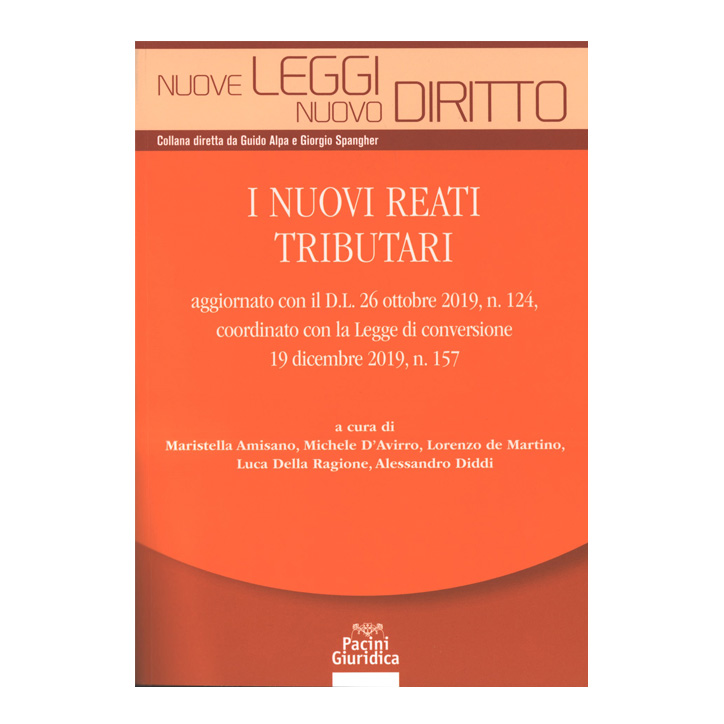
Edited by Mariastella Amisano, Michele D’Avirro, Lorenzo de Martino, Luca della Ragione, Alessandro Diddi
Section II
Ch. I Definitions; Ch. II Tax Avoidance and Criminal Law; Ch. III Fraudulent declaration through the use of invoices or other documents for non-existent transactions (Art. 2 Legislative Decree No. 74/2000) by Michele D’Avirro
Ch. IX Omitted payment of due or certified withholdings (Art. 10-bis Legislative Decree No. 74/2000); Ch. X Omitted VAT payment (Art. 10-ter Legislative Decree No. 74/2000); Ch. XI Undue compensation (Art. 10-quater Legislative Decree No. 74/2000) by Marco Giglioli
Pacini Editore, 2020.
The volume deals with the discipline of crimes in the field of income taxes and value added tax, contemplated in Legislative Decree 10 March 2000 No. 74, as recently integrated and modified by Law Decree 26 October 2019, No. 124, converted with modifications by Law 19 December 2019, No. 157.
In this analysis, it was appropriate to distinguish a general part of tax criminal law, now a testing ground for the main constitutional principles governing the criminal justice system, and a special part, dedicated to individual incriminating cases.
The various topics are analyzed with constant reference to the constitutional and ordinary principles of criminal law, and are explored in a clear and concrete analysis, starting from constitutional principles and reconstructions of the most accredited doctrine, then analyzing individual institutions as they exist in jurisprudence, and finally highlighting virtuous paths and those to be subjected to critical review, including through the proposition of defensive arguments.
Particular attention is given to all the procedural issues that characterize this specific sector of economic criminal law.
Antonio D’Avirro, Marco Giglioli, Michele D’Avirro
Wolters Kluwer, 2017.
The work systematically addresses all the new features introduced in the tax criminal system by the recent Legislative Decree of September 24, 2015, no. 158.
The new tax criminal system aims to reduce the area of intervention of punitive sanctions to only cases characterized by a particular legal disvalue, featuring artificial, fraudulent and simulated behaviors, objectively and subjectively non-existent, considered insidious also with respect to control activities.
Particular attention is paid to the crime of fraudulent declaration through other artifices and to the relationship between the crime of unfaithful declaration and that of false accounting.
The last part of this work, in addition to deepening the discipline of mandatory confiscation of profits from tax crimes, of considerable practical relevance, is dedicated to the in-depth examination of two highly topical issues, namely prescription and the principle of ne bis in idem, on which the extremely important ruling of the ECHR, November 15, 2016, A and B v. Norway, recently intervened, issues that directly affect the difficult relationship between our tax sanctioning system and the European regulatory system.
The volume is a useful and effective tool for addressing the issues that characterize the recently reformed subject.
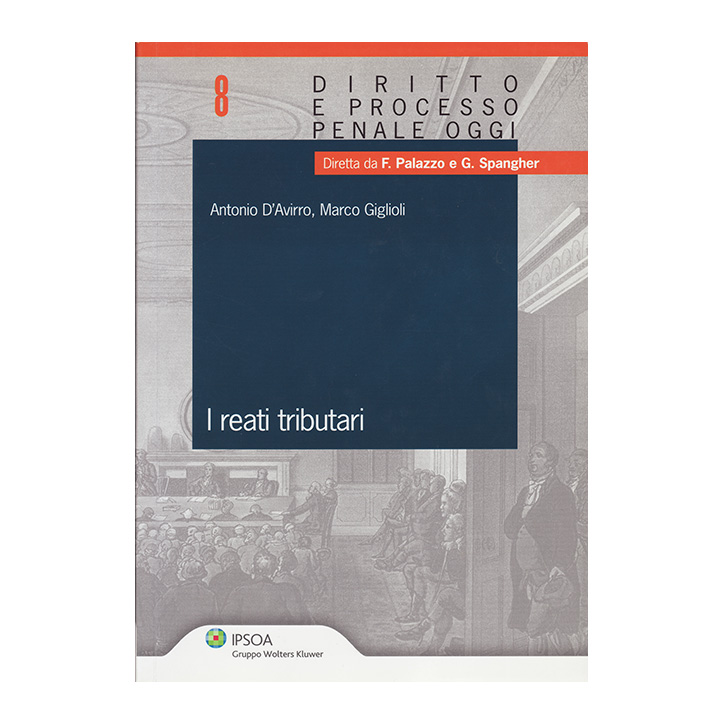
Antonio D’Avirro, Marco Giglioli
Ipsoa, 2012.
The volume, in its two parts, offers a complete overview of tax criminal law (contained in Legislative Decree 10 March 2000, n. 74), describing the main criminal offenses.
Chapter II of Title II of Legislative Decree n. 74/2000 (crimes related to tax documents and payments) has been subject to repeated and significant legislative interventions. In just six years (from 2004 to 2010), the Legislator has, in fact, introduced four new criminal offenses (Articles 10 bis, 10 ter, 10 quater and 11, paragraph 2) that have shifted the center of gravity of the tax criminal system in favor of acts “external” to the tax declaration: failure to pay certified withholdings, failure to pay VAT, undue compensation, fraudulent subtraction from tax payment.
Lastly, with Decree Law n. 138/2011, converted into Law 16 September 2011, n. 148, a series of modifications were introduced in Legislative Decree n. 74/2000, aimed, on one hand, at broadening the scope of application of tax criminal offenses, on the “other, at tightening the penalty system in order to discourage” evasion.
The “work, practical in content and structure, addresses the topic in a specific, updated and comprehensive manner” and represents an indispensable working tool for legal practitioners.

Sabrina Bolognini, Elena Busson, Antonio D’Avirro, Tommaso Ducci, Ubaldo Nannucci
Cedam, 2000.
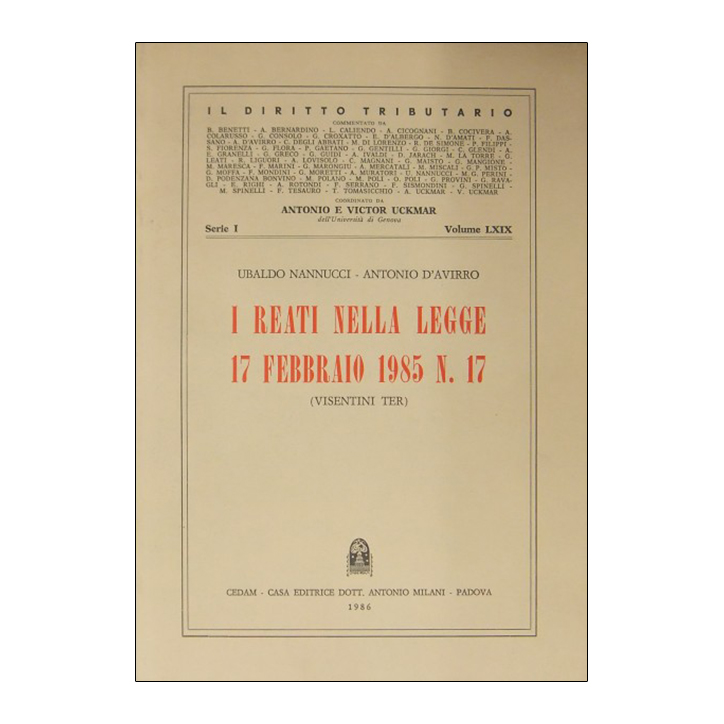
Ubaldo Nannucci, Antonio D’Avirro
Cedam, 1986.
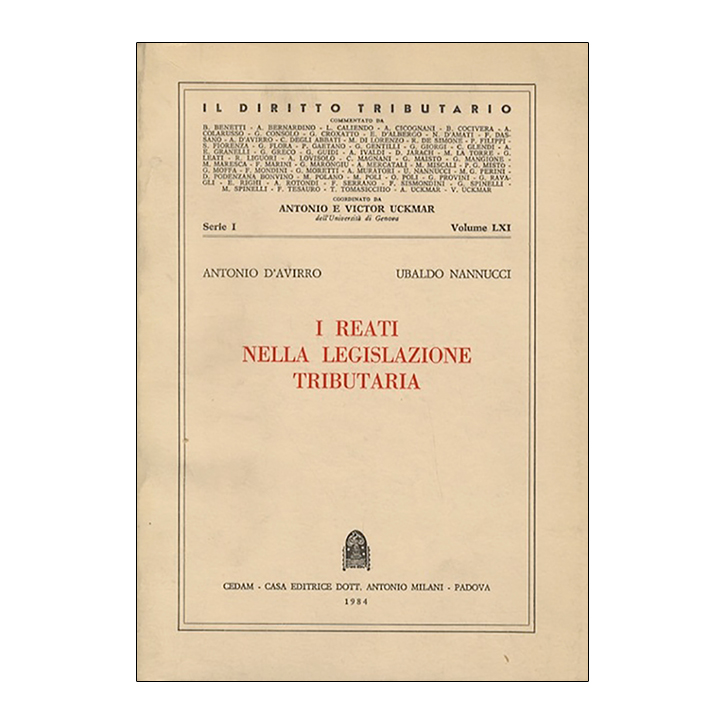
Antonio D’Avirro, Ubaldo Nannucci
Cedam, 1984.
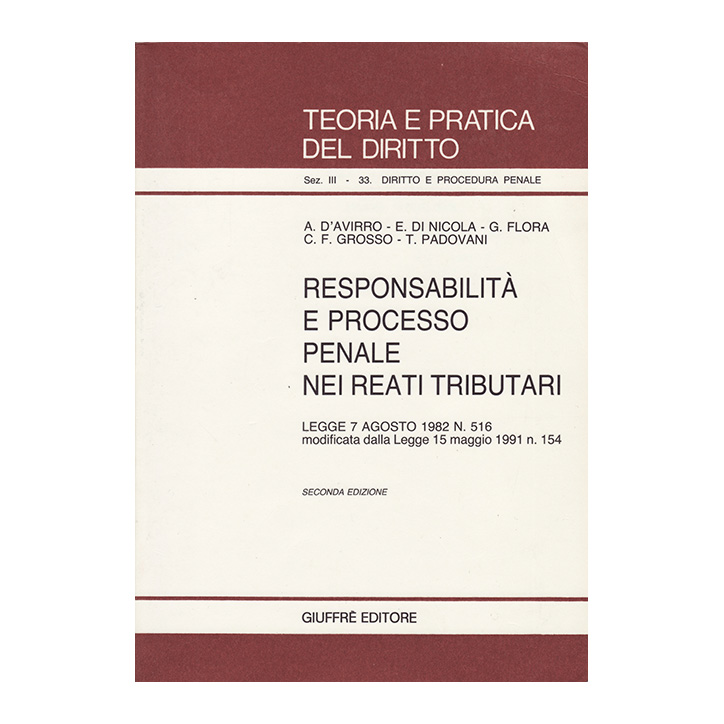
A.D’Avirro, E.Di Nicola, G.Flora, C.F.Grosso, T.Padovani
Giuffré, 1982.