Publications
Bankruptcy Crimes


Bankruptcy Crimes
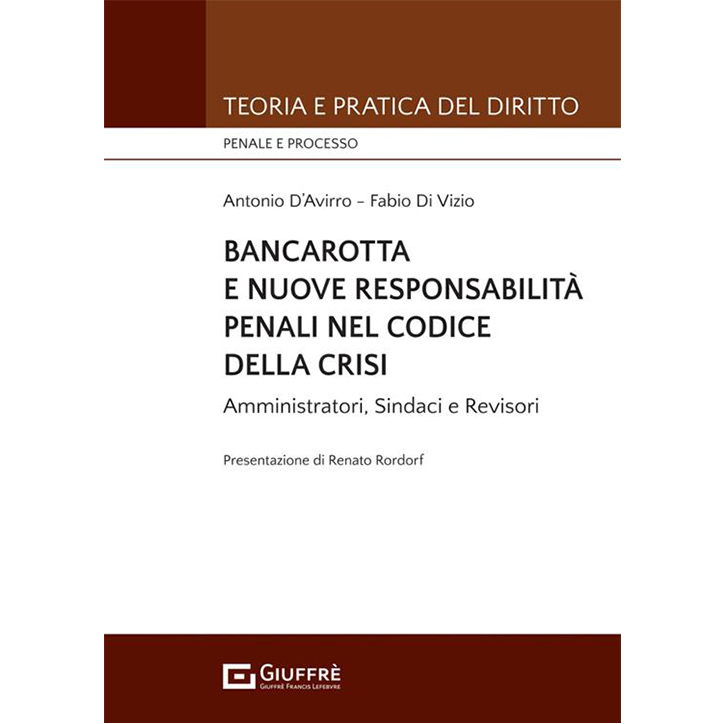
Antonio D’Avirro, Fabio Di Vizio
Giuffré, 2024.
With the entry into force of the Business Crisis Code (Legislative Decree 12 January 2019, No. 14), alongside the liquidation procedures that characterized the 1942 bankruptcy law and which, in situations of imminent insolvency, imposed essentially conservative duties and oversight of the integrity of corporate assets on management and control bodies, initiatives aimed at rehabilitating the company are now widely favored, seeking to preventively overcome insolvency, so as to avoid the dissipation of company value and promote business continuity.
The work aims to verify what the consequences may be, from a criminal perspective, for directors and control bodies regarding the violation of the obligation to act, without delay, in adopting and implementing one of the useful tools for the timely detection of business crisis and for overcoming the crisis and recovering business continuity. These are behavioral duties that may outline omissions that can significantly expand the perimeter of responsibility for those in charge of corporate management, with potential implications for all bankruptcy crimes.
The objective of the work, which is aimed at a broad audience (Magistrates, Lawyers, Accountants, Accounting Experts, Auditors), is precisely to verify the extent to which the changes introduced by the crisis code affect bankruptcy crimes.
To this end, an extensive and complete analysis has been carried out on various crimes of improper bankruptcy (Art. 329, CCI) and simple bankruptcy (Art. 330 CCI), as well as corporate crimes (Art. 2621 et seq. Civil Code) and crimes specific to statutory auditors (Art. 27-31 Legislative Decree No. 39/2010) to understand if new forms of criminal liability for directors, statutory auditors, or auditors can be hypothesized.