Publications
Bankruptcy Crimes


Bankruptcy Crimes
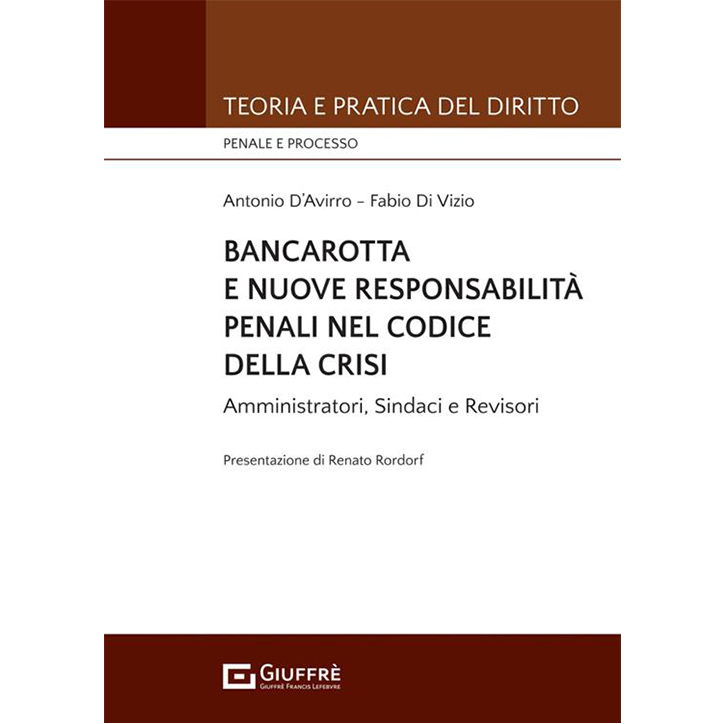
Antonio D’Avirro, Fabio Di Vizio
Giuffré, 2024.
With the entry into force of the Business Crisis Code (Legislative Decree 12 January 2019, No. 14), alongside the liquidation procedures that characterized the 1942 bankruptcy law and which, in situations of imminent insolvency, imposed essentially conservative duties and oversight of the integrity of corporate assets on management and control bodies, initiatives aimed at rehabilitating the company are now widely favored, seeking to preventively overcome insolvency, so as to avoid the dissipation of company value and promote business continuity.
The work aims to verify what the consequences may be, from a criminal perspective, for directors and control bodies regarding the violation of the obligation to act, without delay, in adopting and implementing one of the useful tools for the timely detection of business crisis and for overcoming the crisis and recovering business continuity. These are behavioral duties that may outline omissions that can significantly expand the perimeter of responsibility for those in charge of corporate management, with potential implications for all bankruptcy crimes.
The objective of the work, which is aimed at a broad audience (Magistrates, Lawyers, Accountants, Accounting Experts, Auditors), is precisely to verify the extent to which the changes introduced by the crisis code affect bankruptcy crimes.
To this end, an extensive and complete analysis has been carried out on various crimes of improper bankruptcy (Art. 329, CCI) and simple bankruptcy (Art. 330 CCI), as well as corporate crimes (Art. 2621 et seq. Civil Code) and crimes specific to statutory auditors (Art. 27-31 Legislative Decree No. 39/2010) to understand if new forms of criminal liability for directors, statutory auditors, or auditors can be hypothesized.
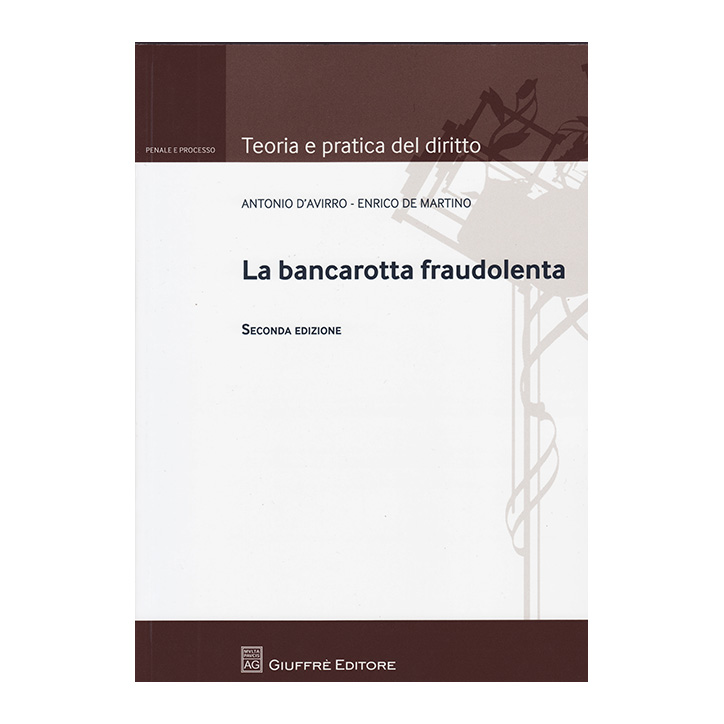
Antonio D’Avirro, Enrico De Martino
Giuffré, 2018.
The work addresses the fundamental topic of fraudulent asset bankruptcy, then proceeds to analyze fraudulent corporate bankruptcy and fraudulent bankruptcy committed with intent or as a result of fraudulent operations.
Particular attention has been paid to the concept of diversion and the relationships between this notion and that of misappropriation or act of disposal provided for by the crime of breach of trust, and to the possibility of including in the distractive conduct of fraudulent asset bankruptcy only those acts through which the administrator determines the irreversible and definitive removal of the company’s assets.
The relevance of the work is given by the most recent jurisprudential references which, starting from the nature of the crime of concrete danger of fraudulent patrimonial bankruptcy, which must consist in the suitability of the distracting act to create a vulnus to the creditors’ guarantees, are enhancing the importance of the criminal risk zone
, which is the one that is close to the state of insolvency, in which the operation is carried out.

Antonio D’Avirro, Enrico De Martino
Giuffré, 2013.
The reform of the crime of fraudulent corporate bankruptcy (Art. 4 Legislative Decree 61/2002) represented a fundamental milestone in the field of bankruptcy crimes. Starting from this premise, the volume analyzes, in the first part, the problematic inference that exists between this crime and that of breach of trust, referred to in Art. 223, paragraph 2, of the Bankruptcy Law, to which jurisprudence has always given a negative response, determining the abrogating effect of corporate bankruptcy due to breach of trust. The second part of the work is dedicated to bankruptcy caused by fraud or as a result of fraudulent operations ex Art. 223, paragraph 2, no. 2, of the Bankruptcy Law, which, from an almost exceptional case, has become the ordinary formula of contestation for most corporate bankruptcies.
The common elements of the conducts provided for by the law and those that differentiate them are analyzed, to arrive at a shared concept of the subjective element of the conduct and its reconnection within intent. The analysis includes the examination of a varied series of concrete case studies, useful for understanding and addressing the enormous variety of conducts that can fall within the concept of fraudulent operations, the recent jurisprudential findings on the matter, and the criminal implications of new procedures for resolving corporate crises.
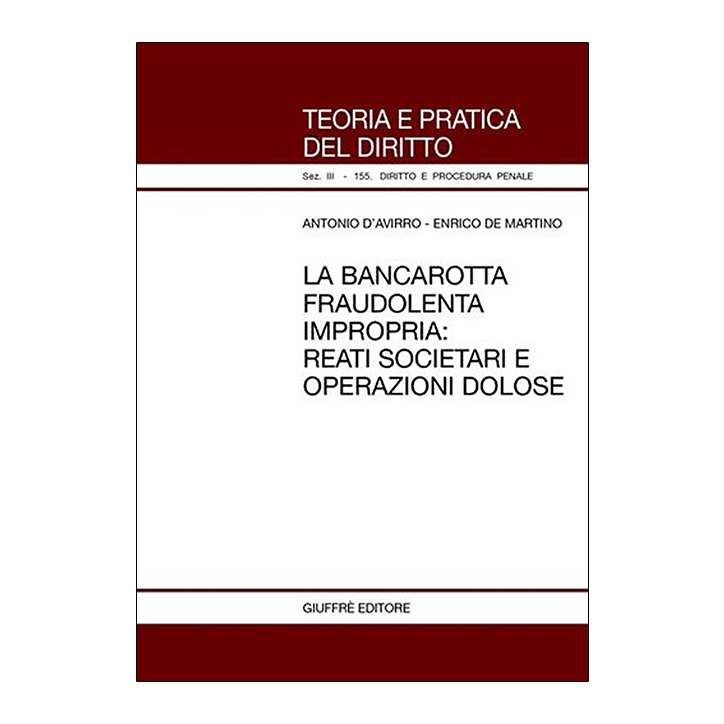
Antonio D’Avirro, Enrico De Martino
Giuffré, 2007.
The reform of the crime of fraudulent corporate bankruptcy (Art. 4 Legislative Decree April 11, 2002 No. 61) represents a fundamental milestone in the field of bankruptcy crimes. The presence of a causal link between the corporate crimes referred to in “Art. 223 II paragraph no. 1 of the Bankruptcy Law and the insolvency, long advocated by legal doctrine and then accepted with Legislative Decree No. 61/2002, probably constitutes an anticipation of what should be the reform of bankruptcy crimes, in which the crime of fraudulent bankruptcy should be linked to the” insolvency of the bankrupt company or at least to a causal relationship between the bankruptcy and the fraudulent conduct. This gives rise to a series of interference problems between the offenses of fraudulent patrimonial bankruptcy and corporate bankruptcy, which are analyzed in the first part of the work.
The second part of the work is dedicated to bankruptcy caused by willful misconduct or as a result of fraudulent operations. We thus witness a progressive rotation of the norm from an almost exceptional case, as a closing norm, to an ordinary formula of contestation for most corporate bankruptcies. However, its progressive and ever-increasing practical application does not coincide with a clear and felicitous formulation: many define this crime – in which acts straddling “civil and criminal wrongdoing rise to criminally relevant conduct – as an ‘enigmatic figure’ of the” legal system.